



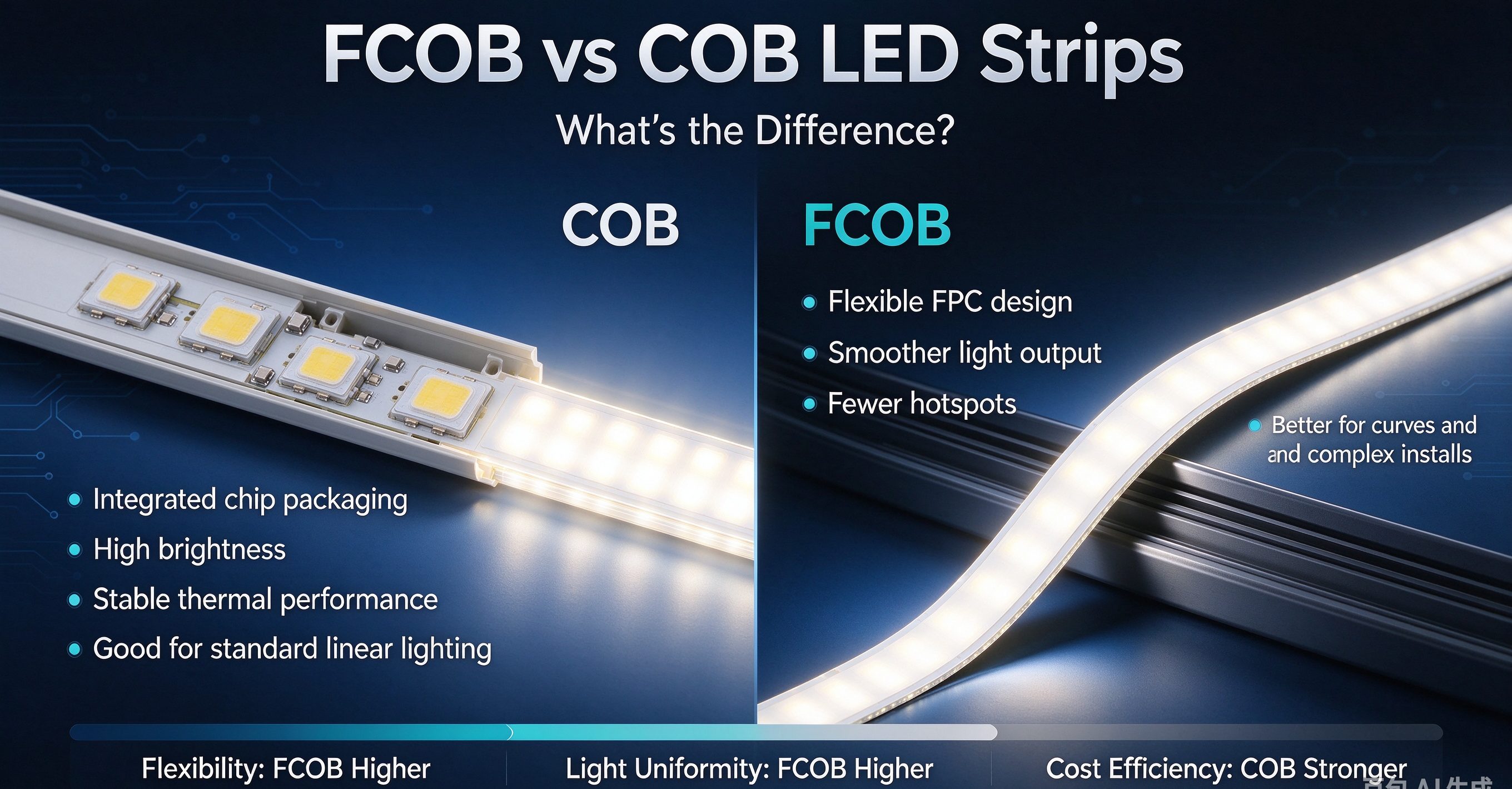
When choosing an LED strip for lighting projects, COB and FCOB are two technologies that often look similar at first glance. Both deliver smoother, more continuous light than traditional discrete LED strips, but they differ in structure, flexibility, and installation performance.
COB, or Chip-on-Board, mounts LED chips directly onto a circuit board and encapsulates them in phosphor material. This creates a compact light source with high brightness and good thermal performance. COB strips are widely used in residential lighting, commercial displays, and architectural accent lighting where reliable linear illumination is needed.
FCOB is an advanced version of COB technology. While it shares the same integrated packaging concept, FCOB typically uses a flexible FPC substrate and a refined chip-placement process. The result is a thinner, softer, and more bendable strip that can follow tighter curves and irregular surfaces. FCOB also tends to provide more uniform light output, fewer visible hotspots, and better resistance to mechanical stress during installation.
The key differences come down to flexibility and light quality. FCOB is generally easier to handle in complex installations, especially around corners, curved profiles, and narrow channels. COB, by contrast, is often a more cost-effective choice for standard linear lighting where extreme flexibility is not required.
In summary, COB offers strong brightness and proven stability, while FCOB improves on that with greater flexibility and more even illumination. For premium projects that demand seamless light and smooth bending, FCOB is usually the better option. For routine linear lighting, standard COB remains a practical and efficient solution.